

Blame the tenant: what 28 years of damp and mould taught me
Scotland's Awaab's Law now says landlords must not assume damp and mould are the tenant's fault. I lived with it for 28 years. This is what that assumption cost.
Since 6 October, landlords in Scotland have had a legal duty to deal with damp and mould within set times. The guidance that comes with it says something I wish someone had said to us in 1991. Landlords “must not make assumptions that reports of damp or mould are caused by the tenant’s actions.”
I lived with damp and mould for about 28 years. For most of that time, we were told it was down to us.
What we moved into
In 1991 we moved into our first flat as a couple. A one-bedroom flat on the top floor of four, in a 1960s block, rented from Link Housing Association.
It had single glazing and storage heaters. In the early years we’d get ice on the inside of the windows in winter, and we’d melt it with a hairdryer. Storage heaters were expensive to run and didn’t heat the place well. So condensation and mould were building up from the start, and we were the ones managing them.
I’ve still got the letter telling us double glazing was coming. It went in in March 1996, and the letter apologises for the delays, because we’d first been told about it in May 1995. Gas central heating followed in May 2000.
The double glazing and the central heating both helped, but neither of them fixed it.
What managing it looked like
Every morning through the winter, we went round the windows with a window vac to suck up the water.
Link did do some repair work over the years, and gave us paint with an anti-mould treatment mixed in. I’m not saying they did nothing. But we never got on top of it.
In the bedroom it got so bad that we took the back off our own wardrobe, just to get some air moving behind it.
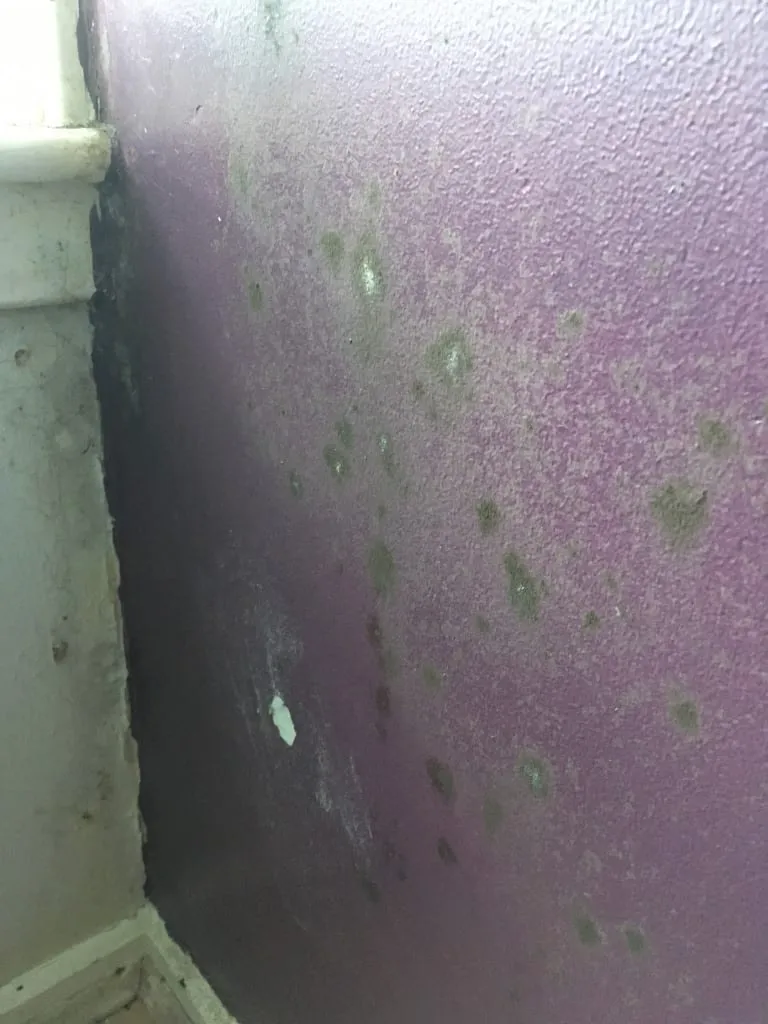
When we finally had to move, the furniture went into the removal van and we saw what had been behind it. There was mould to some degree all over the flat, in places we couldn’t see while the furniture was there.
The bedroom was the worst. We cleaned the mould in there twice a year, but behind the furniture it had kept building up without us knowing how bad it had got. Black mould spreading out of the corner, and green spots all across the wall.
What we were told
The advice, year after year, was to keep the windows open and the heating on over winter. In other words, the damp was down to how we lived, so fixing it was up to us, and so was the cost.
Think about what that means in a top-floor flat in Edinburgh in January. Windows open, heating on, and the meter running. For years the heating was storage heaters that were expensive to run in the first place.
What the law now says
Awaab’s Law is named after Awaab Ishak, a two-year-old who died in 2020 from a respiratory condition caused by long exposure to mould in his family’s home in Rochdale. Scotland’s version came into force on 6 October 2026.
Under the Scottish Government’s guidance for landlords, a landlord now has to investigate a report of damp or mould within 10 working days. If they find substantial damp or mould, repairs have to start within 5 working days. Social landlords then have 20 working days to finish them.
The guidance is just as clear about blame. Landlords must not dismiss a report “on the assumption that the problem is condensation attributable to tenant behaviour.” And it says cooking, bathing, washing and drying laundry “are unavoidable and should not be blamed for substantial damp or mould growth.”
When it lists the causes of condensation, it starts with “inadequate heating, ventilation or thermal insulation.” Those are things about the building. It also opens by saying damp and mould can have a significant impact on people’s physical and mental health.
”A lifestyle issue”
Not everyone in housing is happy about this. In September 2025, David Bookbinder, director of the Glasgow and West of Scotland Forum of Housing Associations, wrote in Scottish Housing News that “there absolutely IS a lifestyle issue” with damp and mould, and that it “needs to be faced up to and not brushed under the carpet.” He wanted the Scottish guidance to recognise it.
He also wrote that “people can’t always afford to heat their home adequately.” He’s right about that. But not being able to afford the heating isn’t a lifestyle. It’s money. And a flat that only stays dry if you can afford to run the heating with the windows open has a problem with the building, not with the people living in it.
The same move I see at work
I spend my working life talking about mental health at work, and this is exactly what I push back on there. A problem built into the place gets handed back to the person as their behaviour, and it costs them to manage it.
At work, it’s stress. Workloads, job design and the way people are managed cause it, and the answer offered is a resilience course. I’ve written about how resilience training asks the wrong person to adapt. At home, it was mould, and the answer was to open our windows.
Either way, the person on the receiving end does the adapting, and pays for it.
Where we ended up
We had to move. Nearly three decades after we moved into that flat, we now rent mid-market from Curb, which is part of the same Link Group.
The law has caught up with what tenants have known for years. Damp and mould are the landlord’s job to investigate and fix, not something for the tenant to live around. Now the people answering the phone when a tenant reports it need to catch up too.
Get new posts by email
New posts most weeks. No spam, unsubscribe any time.
If you'd like to support this blog, you can buy me a coffee.
Buy me a coffee on Ko-fiComments
Leave a comment
Comments appear once I've read them. I'll put up the ones that are about the post and are useful, interesting, supportive or constructive. Anything else won't go up. Your email is never shown or shared.
Loading comments…